| Project
C |
 |
|
Concept “River-Room-Recreation”,
renewable energies, E-mobility
Canopy-shaped PV roofing for Rivers,
Roads and Freeways in order to generate
electricity to use directly for e-mobility
on Freeways, Roads and Waterways, equipped
with overhead lines for electric powered
vehicles. The canal tunnels between the
Inn and the Adige and the bearer frame of
the roofing of rivers and freeways offers
also the possibility for further use of
a suspension light-weight cable railway.
"River Basin Management" - "River
Room Recreation" - Renewable Energy
Sources - Electric Mobility
1. "River
Basin Management" - "River Room
Recreation"
1.1 Flood Control
1.2 Expanding River Sections
to Waterways (Download
PDF)
1.3
Aquacultures
1.4 Development
of Living, Recreational and Leisure Space
at the Waterside
1.5 Redevelopment
of New Available Areas in the Abandoned
River Basin
2. Renewable
Energy Sources
2.1 Photovoltaic –
PV (Download
PDF)
2.2
Wind Turbines
2.3 Hydropower
Stations at the Weirs (Download
PDF)
2.4 Electricity
for the Use of Electric Powered Vehicles
3. Electromobility
3.1 Monorail
overhead conveyors
3.2 Traffic management and
power regulation system
4. Synergies
/ costs
4.1.
Lines located along the motorways - distance
from residential areas
4.2. Carrier cables for overhead
rail tracks - bearing the PV foil covering
4.3. Automation of the motorway
and the overhead conveyor route
4.4. Reliving the roads increases
the quality of life
4.5. Use of local energy
sources
4.6. Short construction time
4.7. Construction costs
4.8. Donau-Tirol-Adria ship
passage and the monorail overhead conveyor
4.9. The earthquakes in Italy
4.10. Financially troubled
Mediterranean countries
5. Outlook
5.1. Congo-Mediterranean
Sea canal
5.2. Sib-Aral-Kasp canal
- global warming
5.3. Connecting the African
and Eurasian continents
5.4. Feasibility
5.5. Appeal
GENERAL
The expected consequences of
climatic change, the economic and financial
crisis and the employment market situation
demand extending the Tyrol-Adriatic Project
to the sectors of flood prevention, renewable
energies, environment, traffic and others.
RIVERS IN NORTH-EASTERN ITALY
The shallow sections of River Adige –
North-East Italy’s longest stream –
come very close to the main ridge of the
Alps. The river thus makes a possible waterway
between the Adriatic region and Danube.
Project B presents the connections
between European inland waterways and the
Adriatic Sea. In order to make
rivers navigable, it is crucial to regulate
their high and low tides.
During the snow melt and autumn rain
periods, the rivers Isonzo, Torre, Natisone,
Tagliamento, Degano, But, Fella, Meduna,
Cellina, Livenza, Piave, and Brenta are
usually in flood and thus feature very broad
riverbeds (partly of several kilometers
width). However, in dry periods the respective
rivers carry only little water (also as
a result of draining for power stations
and irrigation purposes) and are in parts
even dry due to water loss caused by leaching.
Riverside communities as well as the partly
densely populated regions in the lowlands
suffer from being permanently exposed to
this flood hazard. Therefore, projects that
aim at banning the respective risk are given
priority.
The extraordinarily wide river areas
require comprehensive river basin management.
In this course, areas becoming available
may be deployed for new utilization purposes.
The use of hydro power and solar energy
for power generation is potential to be
exploited within the course of the river
basin area’s restructuring.
1. RIVER BASIN MANAGEMENT CONCEPT – "RIVER-ROOM-RECREATION"
1.1
Flood Control
1.1.1 Quick water evacuation
in the event of flood threatens communities
located at the lower reaches and additionally
impedes shipping. On some upper reaches
(e.g. on River Cellina) storage reservoirs
that have the potential to retain water
were built. Within the river courses, up
to 6 meter high inflatable weirs serve to
dam the water to a number of impounding
reservoirs, edged by embankments. The width
of new river beds depends on the respective
river’s profile at the lower reaches.
1.1.2 The respective
top impoundment is to be designed as retention
and collecting basin that serves to retain
larger water volumes as well as sand, gravel
and flotsam and thus reduce the water’s
destructive powers. In order to realize
this, the impoundment ids continuously cleared
by a wire rope conveyor mechanism. Additionally,
the bottom basin is also designed for larger
water quantities in order to be able to
stop the turbine/generator units installed
at the respective weirs or to allow their
function as reversely running pumps that
transport the water back to next top basin
in the event of excess power supply.
1.1.3 At suitable places,
areas for flood control will be used as
so-called polders. In order to facilitate
this flood control system, the respective
areas will be structured as terraces. In
the event of flood hazards, a controlled
amount of water can be directed to respectively
designated spots and – by partially
elevating the water level – flow into
the polders.
1.2 Expanding
River Sections to Waterways
1.2.1 By equipping weirs
with ship locks, electrically operated ships
can also navigate rivers used as waterways
all the way to important business locations
in the valley. This applies e.g. to Merano
at the River Adige, Goerz at Isonzo River,
Ponte al Tagliamento, Nervese della Battaglia
at Piave River or Bassano del Grappa at
Brenta River.
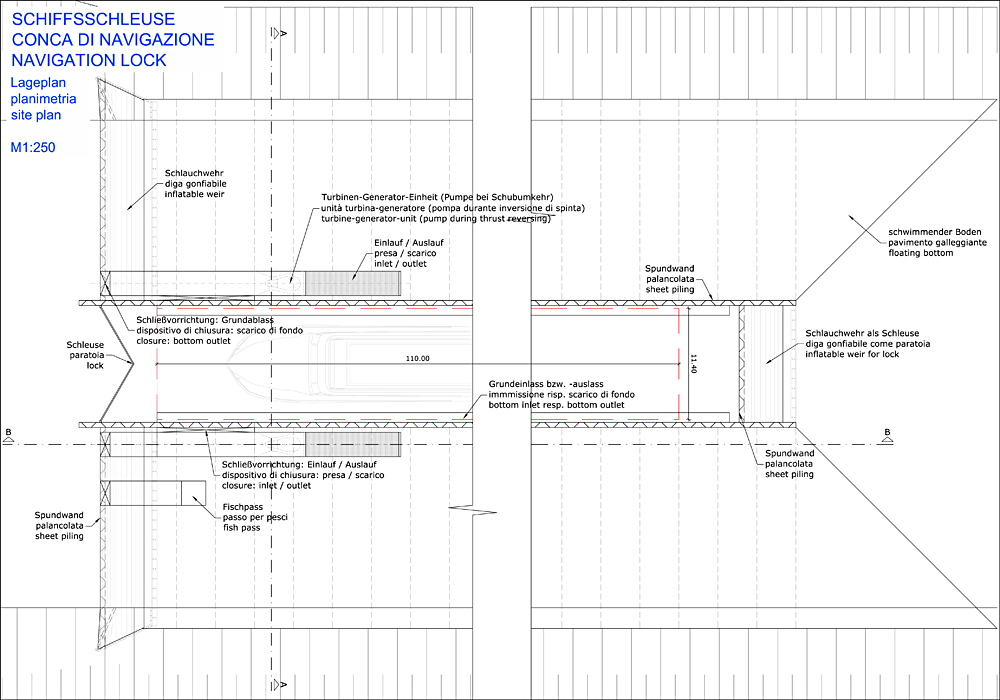
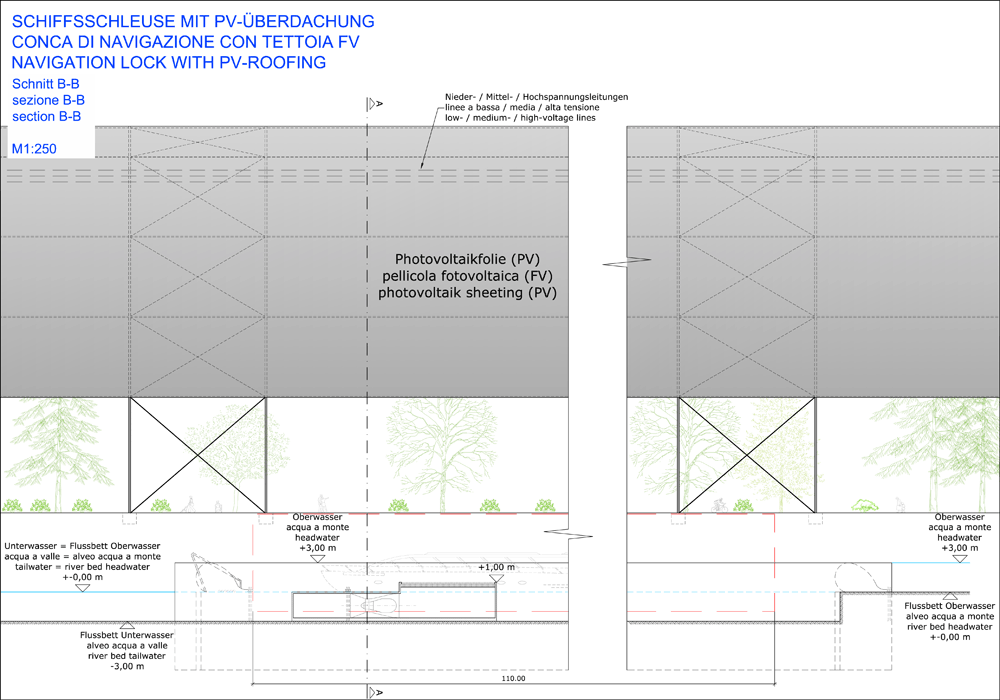
1.2.2
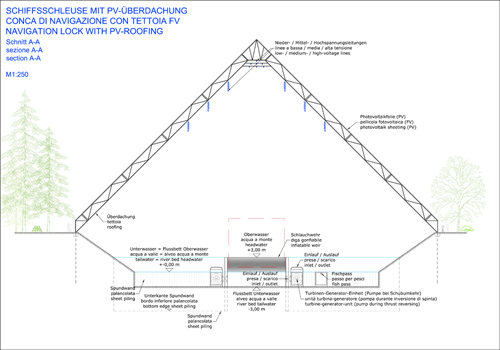
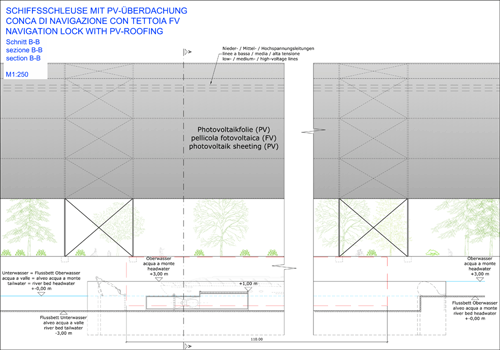
Ship locks: the ship lock of 112 m or 224
m length and 12 m width will be erected
right in the river’s bed with as sealed
sheet pile walls, which are horizontally
supported in direction of the respective
river bank’s crest. The support structure’s
watertight sheathing creates an air cushion,
which – being covered by floor slabs –
turns into a walkable and trafficable surface
floating on the headwater. Each ship lock
provides the option for a bridge to the
other side that allows for crossing the
river. The ship lock’s locking components
will be opened in the event of flood in
order to allow the water’s unimpeded
drain via the lock, which does thus not
constitute any obstacle or constriction
to the river’s profile.
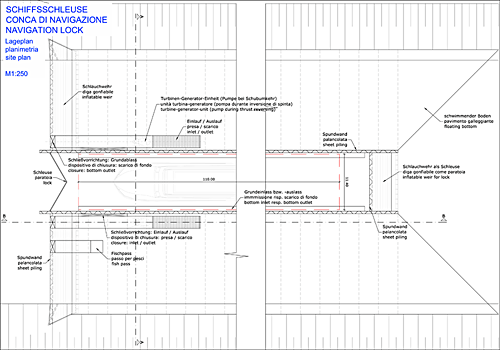
1.2.3 Inside the lock,
the water level is lifted or lowerred by
means of pump turbines that pump retained
headwater in or out through the channels
flowing in at the sides.
1.2.4 Padova-Mare Waterway:
in this context, it is intended to intergrate
currently incomplete Padova-Mare Waterway
with the inland waterway of Brenta River,
equip it with a PV cover for power generation
and open it for ship traffic.
1.3
Aquacultures
1.3.1 Within the respective
impoundments, the volume of water will be –
compared to the current level – increased
many times over especially with respect
to residual water ways. Given the present
water quality, this will create good conditions
for aquacultures, in particular for pisciculture.
Since different species and sizes of fish
will be kept in separate impoundments, fish
migration is undesirable; a fish pass is
thus not required. If necessary, the system
facilitates a practicable crossing.
1.3.2 In a time of
the seas suffering from overfishing, this
new industrial sector (pisciculture in ecological
river systems) globally faces a promising
future. It is thus promoted by both, the
Italian Republic as well as the EU. The
Act No. 57 as from 03/05/2001 aims at supporting
rural development and employment in the
sectors of farming and pisciculture (aquaculture)
and enhancing environmental protection and
landscape conservation.
1.4
Development
of Living, Recreational and Leisure Space
at the Waterside
1.4.1 In the river basin,
larger areas of water will be created to
improve the scenery and – due to the
increased evaporation rate – additionally
ensure more pleasant climatic conditions.
In the cities and other communities located
at the waterside, the river will be given
a new appearance: while the river bed was
previously nearly empty due to draining
or – depending on peak power generation
- at times and certain sections nearly empty
or filled with roaring masses of water,
the river will now spread a peaceful atmosphere.
1.4.2 This newly found
situation as waterside city or community
will ensure the emergence of aquatic facilities
for water sports, fishing spots at the riverside
and recreational areas at suitable places.
At the inflatable weirs, passages (slides)
for boats might be set up.
1.4.3 Both, the aquacultures
as well as the river basin’s development
into living, recreational and leisure waterside
space will open new perspectives for the
inhabitants’ lives, activities and
economic situation.
1.5
Redevelopment
of New Available Areas in the Abandoned
River Basin
Areas formerly occupied by the river
and now becoming available – located
outside the newly created river bed –
will be used for new purposes such as for
instance:
1.5.1 Transport
Routes
It is intended to build
traffic lanes for motor traffic, bikeways
and footpaths on the embankments at both
sides of the river. These will be connected
to the traffic routes existing in the communities
located at the waterside. One lane into
each direction might be adapted for the
use of electric powered vehicles.
1.5.2 Cultivated Agricultural
Areas
More than 10,000 ha of
abandoned areas in the river basin will
be used for agricultural purposes such as
rice growing. Depending on respective cultures
grown thereon (tomatoes), they might also
be roofed and used for PV power generation.
The respective areas’ irrigation should
be realized by installing efficient and
yet water-saving systems.
1.5.3 Theme and Recreational Parks,
Sports Facilities, Tourist Facilities
1.5.4 Animal Reserves
1.5.5 Green Pastures
This allows for transforming the rocky and
sandy deserts in said North-East Italian
river valleys (that can even be seen from
outer space) to “green pastures” –
in order to quote former German chancellor
Kohl’s comment on the fall of the
Berlin Wall.
In times of agricultural
land shortage, desert landscapes along riversides
are nonsense.
The presented concept
for river basin management can be appropriately
summarized by using the term “River-Room-Recreation"
(“RRR” in short).
1.5.6 The restructuring
and cultivation of respective riverside
areas also includes the utilization of renewable
energy sources.
2. ELECTRICITY GENERATED FROM RENEWABLE
ENERGIES
2.1
Photovoltaic –
PV
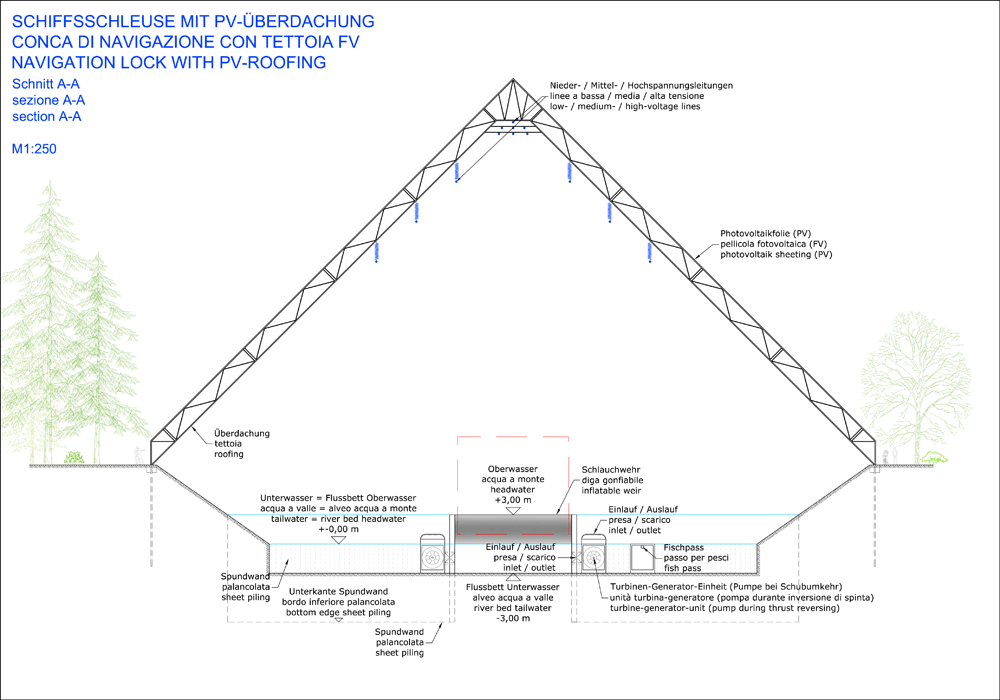
2.1.1 Canopy-Shaped PV Roofing
for Rivers and Channels
Rivers
and shipping channels are supposed to be
covered with solar film that is affixed
to span roof-shaped steel framework structures.
The bearer frame’s supports will be
piled in on both riversides and –
with rather broad rivers – additionally
in the river bed. The membrane roof is intended
to feature a slope of 45 degrees and laterally
stop at a height of 5 meters in order to
ensure the snow’s safe skidding into
the river and unhindered view onto the water.
Rivers are continuous spaces (corridors),
which makes perfectly suitable for pipeline
routes.
The membrane covering’s
bearer frame might accommodate
- power
lines for various voltage levels;
-
supply and overhead lines for inland vessels
powered by electricity; and
- lanes
for overhead tracks.
- Danube-Tyrol-Adriatic Waterway –
Project B
If the waterways on the Rivers Inn and
Adige, from Passau at River Danube all the
way to Venice, were roofed with film on
a length of Adige 620 km (in the open),
this would result in a film-covered surface
of 62,000,000 m² (620,000 m length x 100
m width).
Assuming from a rate of 100
kWh/m², this will result in a nuclear power
station’s annual output of 6,200,000,000
kWh or
- an annual output of 10,000,000 kWh
per km of waterway.
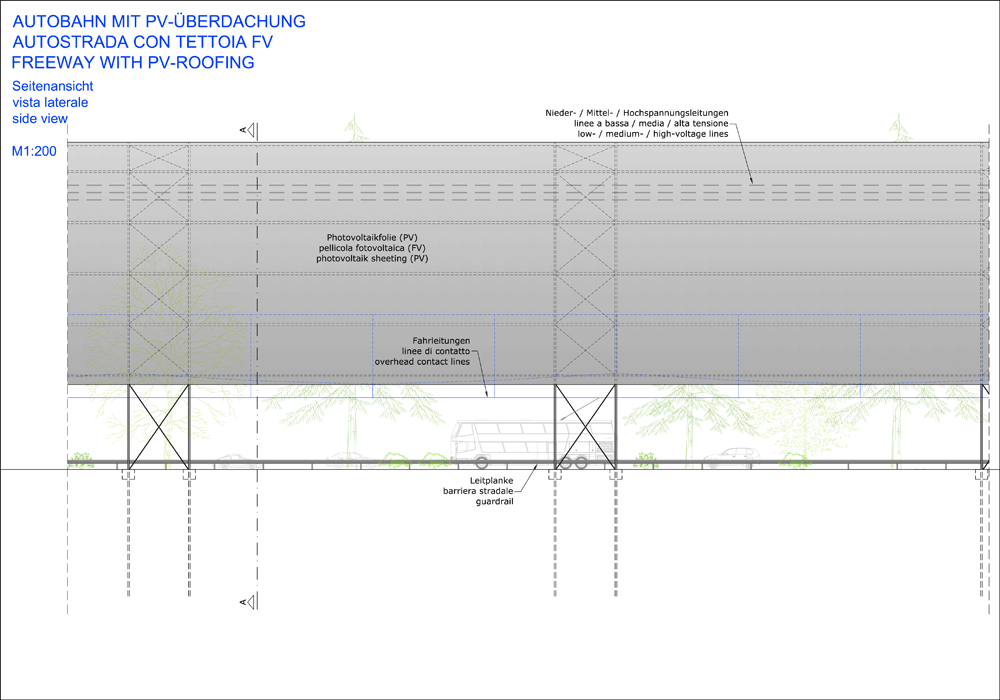
2.1.2 PV Roofing
for Roads and Freeways
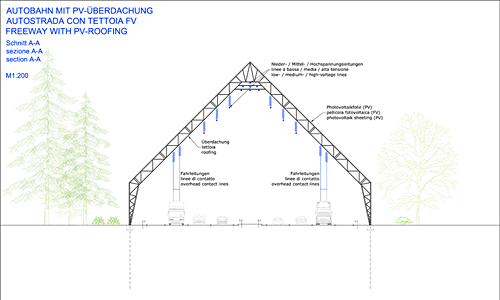
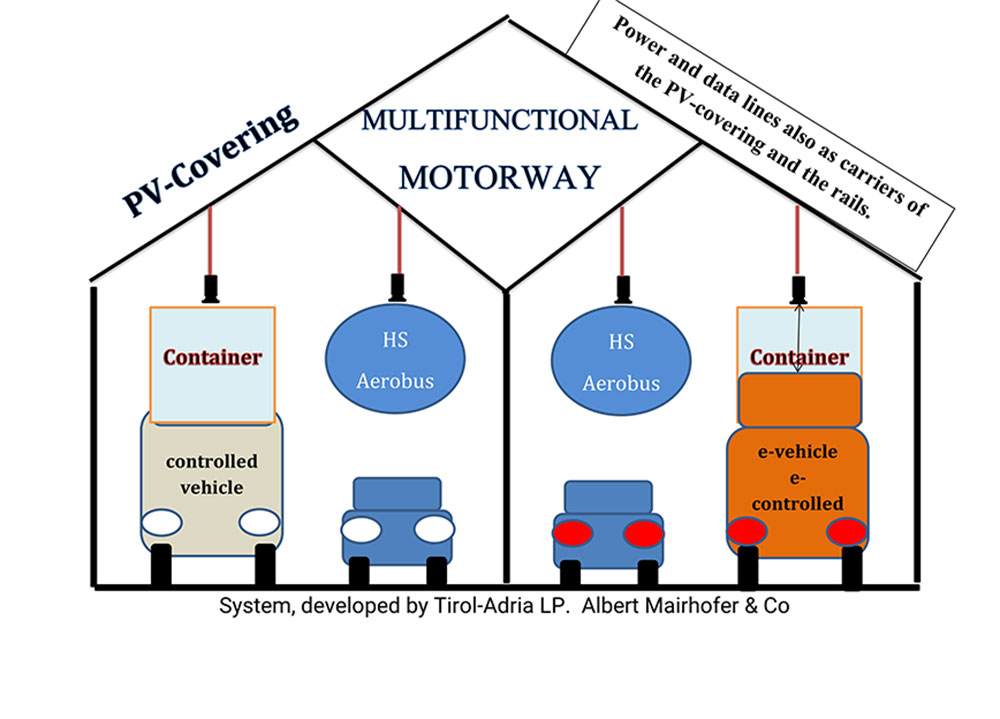
It is furthermore intended to also cover
roads and freeways with PV film in order
generated solar energy. Suchlike roofing
would be realized in the form described
above.
- per each kilometer of road 1,200,000
kWh and
- per each kilometer of freeway 4,400,000
kWh of electricity could thus be generated
per year.
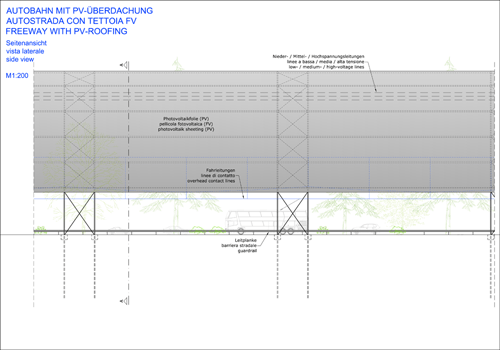
2.1.2.1 Power Lines
Underneath said covering, power lines for
various voltage levels as well as one overhead
line for electric vehicles per each direction
could run.
2.1.2.2 Positive Side
Effects of PV Roofing or PV Canopy:
- snow-free traffic lanes;
- no formation of ice or hoarfrost;
- no snow clearance, no use of de-icing
salt or winter road sand required;
- longer pavement life;
- possible noise reduction;
- unhindered view to both sides of
the road.
2.1.3 PV Roofing for Sports Stadiums,
Intensely-Used Agricultural Land or Wherever
Roofing Facilitates Multiple Use
2.1.4 PV Elements Floating on
Water Surfaces e.g. Uncovered Reservoirs.
2.2 Wind
Turbines
In order to utilize the updraft created
by the air heated underneath the roofing,
wind turbines will be installed horizontally
in the roofing’s gables. However,
since respective empirical values are not
available, their output cannot be estimated.
2.3
Hydropower
Stations at the Weirs
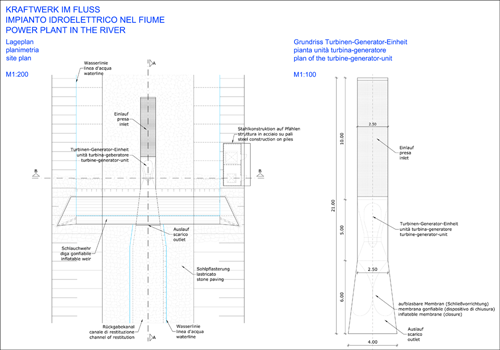
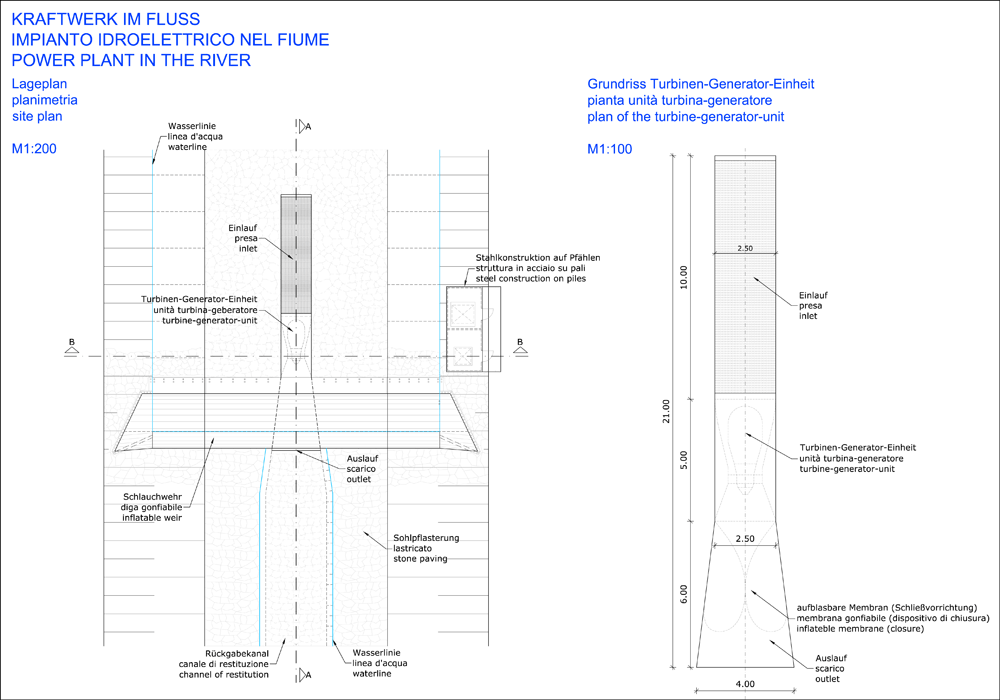
2.3.1 At the individual
weirs, sub-aqueous turbine generator units
will be installed to generate electricity
by using the available water and differential.
Running reversely (thrust reversal), these
units serve to pump to the respectively
next higher basin and – in the event
of excess supply – take electricity
from the mains and save it as renewable
energy.
2.3.2 In
order to compensate production and consumption
capacities, high-pressure pump storage hydro
power stations will additionally be built
in order to especially compensate output
peaks and to optimize the electric current’s
transport through the power line network.
2.4
Electricity
for the Use of Electric Powered Vehicles
The plants for power generation and transport
are positioned alongside said main traffic
routes (waterways, railway, freeway, national
and federal roads, bikeways) and are thus
ideal to:
2.4.1
feed the grid for electrified lanes on freeways,
roads and waterways;
2.4.2
directly operate high-performance quick
charging stations for electric powered vehicles,
provided at roadhouses and parking areas
(Park & Charge).
2.4.3 Furthermore, the
electricity might be fed into the railway
supply system since the power station will
be built in its direct proximity.
3. ELECTROMOBILITY
Two traffic arteries run through the
AlpenKanalTunnel:
- The Donau-Tirol-Adria waterway
and in the tunnel arch the
- Monorail overhead conveyors –
Munich-Innsbruck-Verona, as well as
- power and data lines.
This leads to the realisation that transportation
paths and waterways are suitable as continuous
corridors for intensive and multiple use
and therefore should be used.
3.1 Monorail
overhead conveyors
Photovoltaic covering of motorways
and roads as well as waterways
- for power generation
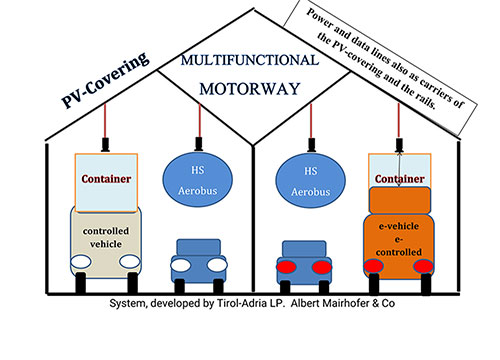
- for the mounting of the multifunctional
rail as a transport, power and guide rail
and
- for the housing of power and data
lines, which in turn act as carriers
for the PV covering and the multifunctional
rail.
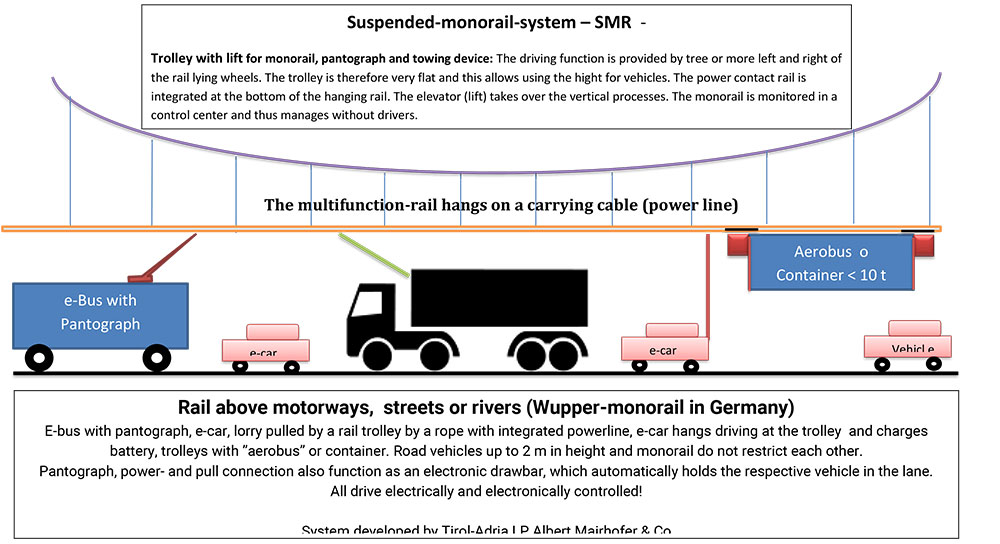
3.1.1 At least one lane
in each travel direction will be equipped
with an overhead line for an electrical
vehicle. The overhead line will
be a multifunctional rail with an integrated
continuous or alternating current line and
conductive track at a height of 5 m.
3.1.2. Trolleys
with a lift roll above the 1st lane
3.1.2.1. For the suspended transport
of people and goods in cabs, containers
(<10 t), etc.
3.1.2.2. For towing and controlling
vehicles without their own drive
(trailers) for loads that cannot be hung
for transport or for diesel lorries during
a period of transition
3.1.2.3. For the transfer of power and control
data to e-vehicles.
Battery-operated vehicles can be charged
during travel,
3.1.2.4. For operating a high-speed
monorail overhead conveyor – Aerobus
above the (last) passing lane.
In the case of a 2-lane road, the rail for
the possible high-speed monorail overhead
conveyor would run at the top approx. 7.5
metres below the PV covering.
3.1.3 The monorail
overhead conveyor system permits
groundbreaking applications. It is the road
itself that provides electricity to the
passenger and goods traffic on the rails!
This is made possible by the special type
of multifunctional rail instead of an electrical
overhead line and the very flat undercarriage
(trolleys with lift)
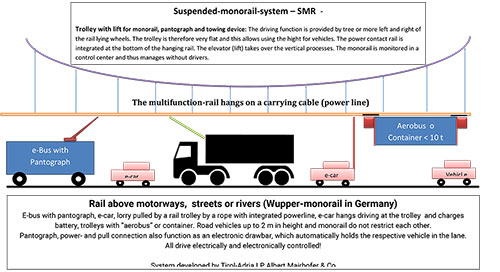
3.1.4. This Aerobus cabs are designed in
this case to be very flat and up to 2 m
high and 3 m wide, so that the underlying
rail permits driving lorries with a height
of up to 2.5 without limitations.
3.1.5. The aerodynamic shape of the overhead
conveyor causes the pressure on the undercarriage
and the rail to decrease as the speed increases,
giving passengers the feeling they are flying.
3.1.6. For tall heavy-duty vehicles, it
is not reasonable to use the passing lane,
therefore the respective traffic route will
also be improved due to electronic control
as regarding driving safety, environmental
influences and performance.
3.1.7. The first lane will be used by the
overhead conveyor and road vehicles,
whereby lorries with a height of
up to 2 m and the overhead conveyor will
not limit each other.
3.1.8. Due to electrification, environmental
damage due to exhaust gases will be eliminated
and noise pollution will be reduced.
3.1.9. In the future, the vehicles should
be driven only by electricity due to the
multiple advantages (efficiency). Heavy
e-vehicles will still be equipped with a
compact power generator which ensures a
power supply along routes that are not electrified.
3.2 Traffic
management and power regulation system:
3.2.1 The multifunctional
rail should also integrate a guidance and
monitoring system that permits automated
driving, which considerably increases driving
safety and the performance of the motorway.
3.2.2 Every electrically
operated bus or lorry that takes power from
the overhead line on the electrified roads
is equipped for driving on non-electrified
routes with a power generator with power
of approx. 200 kWel or - in the future -
with a more powerful battery. This can be
put into operation by the power regulation
system within seconds and any overcurrent
can be returned to the mains via the same
overhead line, turning an electricity consumer
into an electricity provider. 10,000 lorries
(in comparison: 6,000 lorries drive through
the Brenner Pass every day) can provide
the power of 2 nuclear power plants, i.e.
2,000,000 kW and therefore support the power
network. For example a local overload of
the power network could be counteracted
by the activation of ancillary equipment
or the battery of electric vehicles in the
concerned area.
3.2.3. The electrification and automation
of traffic is already possible today with
existing technology.
4. Synergies / costs:
4.1. Power supply lines are
located along the motorways and therefore
are at a sufficient distance from residential
areas;
4.2. Power supply lines also
act as carrier cables for overhead rail
tracks or as isolated power cable for bearing
the PV foil covering;
4.3. The automation
(electronic control) of
the motorway and the overhead conveyor route
is made possible by these new structures
and not only permits safer driving and reduced
operat-ing costs, but also allows an increased
and more environmental friendly throughput
of passen-ger and goods transport.
4.4. Reliving the roads
increases the quality of life
4.5. Use of local energy
sources: The drive energy is generated
in a renewable manner from the PV covering
and in the hy-dropower plants along the
traffic arteries and then made available.
4.6. Short construction
time: This plant can be constructed
without greatly disturbing the surrounding
area. The compo-nents will be delivered
already prefabricated and installed and
commissioned on site.
4.7. Construction costs:
The costs of the monorail overhead conveyor
in comparison to a traditional railway can
be re-duced by much more than half and when
the synergies are used optimally, the costs
can be reduced to approx. 1/10 of the costs
in comparison to an Italian high speed railway
= approx. 5-6 million €/km.
4.8. The Donau-Tirol-Adria ship
passage and the monorail overhead conveyor
will allow Europe to save many billions
of Euros in expensive projects, including
the high-speed lines such
as the BBT. as we have also realised that
mixed traffic will not be possible, or freight
transport does not make sense along such
routes, and therefore we cannot expect any
relief for the motorways!! The required
access routes to the Brenner base tunnel
would therefore also not be necessary.
4.9. The earthquakes
in Italy also create doubt regarding
the safety of the “TAV”.
Should billions be invested in high-speed
trains, when the overhead conveyor system
is much safer as derailing is not possible
- and for a mountainous country such as
Italy, it is much more suitable and also
has the advantages indicated above.
4.10. The most important aspect
of the canal through the Alps is that financially
troubled Mediterranean countries would get
closer to Europe and Europe would be closer
to the Mediterranean, which would valorise
Europe as a business location and create
new perspectives. This would lead to a European
wide shift to inland and coastal vessels
and to the monorail overhead conveyor system,
thereby leading to great savings in time
and energy.
5. Outlook:
On the basis of the Tirol-Adria project,
it would be possible to unite the
“Transaqua”, “Interafrica”
(Congo-Chad-Libya water transfer)
http://www.transaquaproject.it and
“Desertec”,
the solar power bridge
to Europe, creating the
5.1. Congo-Mediterranean
Sea canal
By diverting approx. 3,000 m³/s (a second
Nile) from Ubangi, the largest tributary
on the right side of the Congo, would create
a navigable waterway through the
desert, which would directly involve
only 3 countries: Central Africa,
Chad and Libya. Lake Chad could
revert back to its original condition, the
provision of water for the "Great
Man-Made River" could be ensured
also for the future and desert could be
transformed into fertile land.
The PV covering of the waterway
prevents evaporation and provides power
for the pumping stations, for local use
and for feeding to the lines that can be
installed due to the covering.
- The covered waterways permit the installation
of a fast monorail overhead conveyor- (Wuppertal
suspension railway) as well as a power rail
for the electric operation of inland vessels.
A great step in the direction of electromobility!
5.2. Sib-Aral-Kasp
canal - global warming
This plan (Dawydow Plan) for diverting
approx. 500 km³ of water per year (500,000,000,000
m³ per year = 16,000 m³ per second) that
flows from the south to the north, through
Siberia to the Arctic Ocean in the Ob/Irtysch
and Jenissei rivers to the arid south, to
the Aral Sea that is running dry, would
have great impacts on limiting global warming.
This water, which is on average 10° C warmer,
would no longer flow to the -1.6° to -1.9°
C cold Arctic Ocean, rather to the warmer
yet dry south and be used for cultivation,
and more indirectly for a more comfortable
climate. A multiple effect!
The Arctic Ocean would receive approx.
5,000 TWh (terawatt hours)
(5,000,000,000,000 kWh) less
of thermal energy, (basis: 1 kWh heats up
1 m³ of water by 1°C), which corresponds
to the yearly power production of
625 atomic power plants
or 1,000 times the power production of South
Tyrol.
The example of oil production in
Saudi Arabia: The heat released
by the combustion of 70 % of produced oil
(approx. 1,800,000 m³ daily = 20,800 litres –
a full tanker - every second) would approximately
equal this amount of heat!
A waterway with power and gas lines that
can be navigated all year long and a modern
high-speed overhead conveyor to the Caspian
Sea and to the Mediterranean would make
resource-rich Siberia more accessible and
bring the economic areas around the Mediterranean
sea closer.
5.3. Connecting
the African and Eurasian continents in the
Mediterranean Sea!
The power lines and the monorail overhead
conveyor could be continued along motorway
or road coverings from the Mediterranean
Sea ports at the mouth of the canal from
Sirte in Libya to the straights between
Tunisia and Sicily and bridge the
Mediterranean Sea on pontoons, thereby connecting
the African and Eurasian continents in the
Mediterranean Sea. The rails of the overhead
conveyor would cross the canal from
Sicily and the Straight of Messina
hanging from the high-voltage line (Africa-Europe
solar power bridge), as can be seen in this
impressive video!
This means creating access to
the large, hardly accessible area between
Congo to the Mediterranean Sea, providing
a direct connection for the navigable rivers
of the Congo Basin and Siberia to the Mediterranean
Sea, and therefore to Europe. These works
that connect continents would be able to
open up new perspectives for African populations
and therefore stop the stream of refugees!
5.4. Feasibility
To eliminate any doubt about
the feasibility of the Congo-Mediterranean
Sea canal, I would like to give a simple
example:
Saudi Arabia produces 11,700,000
barrels of oil per day, which corresponds
to a daily delivery rate of 1,800,000 m³.
One kilometre of a channel that is 100 m
wide and 10 m deep corresponds to an excavation
of 1,000,000 m³ and in comparison it would
be possible to excavate 1.8 km of canal
every day, 500 km a year and the entire
3,000 km long channel in 6 years! Besides,
modern technology can still revolutionise
canalisation.
5.5. Appeal
I think the time has come to
convert tanks into excavators! Therefore
I am making the appeal to make this large
project into a concern for all of humanity
and to implement it before the water of
the Congo is only used as an energy source
in the largest power plant in the world
at the outflow to the Atlantic Ocean, as
the entire area north of the Congo is longing
for water and the consequences of global
warming are becoming increasingly evident.
PS: The plans created by the South
Tyrolean Alois Negrelli for the Suez Canal
were implemented decades later by Lesseps!
We do not have that much time!
Tirol-Adria
Project Ideator & Manager: Albert Mairhofer
As of May 2019
|